




AI Detector
and AI Checker.
Paste any text and get an AI likelihood score in seconds. No sign-up required. Detects content from ChatGPT, Claude, Gemini, DeepSeek, and more.
- No sign-up required
- Supports 50+ languages
- Detects ChatGPT, Claude, Gemini, DeepSeek
DEFINITION
What Is an AI Detector.
An AI detector is a tool that estimates the probability that a piece of text was generated by a language model. The same tool goes by several names: AI detector, AI checker, AI content detector, and AI text detector all describe the same thing. Whatever the name, the job is identical: read the text, measure its patterns, and return a score.
The analysis works on the text alone. The detector does not inspect metadata, file history, or where the text came from. Paste a paragraph from any editor, document, or chat window, and the result is the same, because the only input that matters is the writing itself.
The output is an estimate of likelihood, not a verdict on authorship. A score tells you how closely the text matches patterns typical of machine generation. What you do with that signal depends on your workflow: review, rewrite, or publish as is.
HOW IT WORKS
How AI Detection Works.
Machine-generated text carries measurable habits. The detector scores four of them and combines the result into a single number.
Predictable word choice.
A language model picks the statistically likely next word at every step. Human writers do not. The detector measures how expected the text is: when every sentence continues exactly the way a model would continue it, the likelihood score rises.
Uniform structure.
AI text gravitates toward sentences of similar length and identical construction. Human writing is uneven, with short statements next to long ones and fragments next to full clauses. High structural uniformity is one of the strongest machine signals.
Repeated language markers.
Models reproduce certain stock phrases and transitions far more often than people do. A few of them in one text mean little. A consistent density of them in every paragraph is a measurable pattern.
Statistical, not semantic.
The detector does not read for meaning. It compares the statistical distribution of the text against distributions typical of machine generation and of human writing. That is why it works on any topic and in any supported language.
All four signals are statistical. The detector compares your text against what machine writing and human writing typically look like, which is also why longer samples give steadier results: more text means more data for the comparison. No detection system is perfect. Accuracy depends on text length, topic, and writing style.
Score Guide
How to Read Your Score.
The AI score runs from 0 to 100. Lower means more human-like patterns. Higher means more AI-like patterns.
Likely Human
Strong human-like patterns. The text reads naturally, with varied structure and phrasing typical of human writing.
Possibly Human
Mixed signals leaning human. Some AI-like patterns are present but the text shows enough natural variation.
Possibly AI
Mixed signals leaning AI. Consistent structure, predictable phrasing, or repetitive patterns suggest AI generation.
Likely AI
Strong AI-like patterns. The text shows high consistency, uniform rhythm, and structure typical of AI-generated content.
The number is a probability estimate, not a statement of authorship. It reports how strongly the text matches machine patterns, and that is the full extent of what it says. Use it as a signal for where to look closer, not as a basis for conclusions about who wrote the text.
Text length matters. The checker needs at least 30 words to produce a signal at all, and results stabilize from around 100 words. Short fragments swing more because there is less data for the statistical comparison. If a score on a short passage surprises you, check a longer sample before drawing conclusions.
Two different detectors will give two different numbers for the same text. Each tool uses its own heuristics, training data, and thresholds, and there is no universal standard for AI detection. The practical workflow: score the draft, review the passages that read most mechanical, rewrite where needed, and score again. Treat the number as an editing signal inside your process, not as a verdict to act on by itself.
LANGUAGES
Detection Across 50+ Languages.
Detecting AI text outside English is harder than it looks. Most detection tools are trained primarily on English data, so their scores turn unstable the moment the text switches language: the same tool that behaves sensibly on an English draft can produce noise on a Spanish or Japanese one.
HumanTone's detector supports 50+ languages with stable results across supported languages. The analysis is statistical rather than semantic, so the same signals it reads in English, such as structural uniformity and predictable phrasing, are measurable in other languages too. Language, topic complexity, and writing style still influence the score to some degree, which is true in English as well.
If you work with multilingual content, the full list of supported languages for detection and humanization lives on the languages page.
Detection
Works Across All Major AI Tools.
The detector analyzes linguistic patterns and statistical signals in the text itself, not metadata or source. It works on output from any AI writing tool, including open models such as Llama and Mistral, and on text that passed through several tools on its way to you.
Each model also leaves patterns of its own. ChatGPT leans on formulaic openers and bullet structure, Claude on em dashes and hedging, Gemini on headers, DeepSeek on extended preambles, Grok on register shifts, Perplexity on encyclopedic tone. The detector reads all of them as machine signals. If you want to remove a specific model's patterns rather than just measure them, each one has its own page:
The score does not tell you which model wrote the text. It tells you how strongly the text carries machine patterns overall, whichever tool produced them.
Detection analysis
WHO USES IT
Who Uses an AI Detector.
The common thread is quality control at scale: a fast, objective signal about how text reads before it goes anywhere.
SEO SPECIALISTS
Score drafts at scale before they go live. A quick check on every piece keeps quality consistent across hundreds of pages without reading each one line by line.
CONTENT TEAMS
A shared benchmark for editorial quality. Every writer and every batch gets scored the same way, so standards stay objective as the team grows.
MARKETING AGENCIES
Spot-check contractor and freelancer material as part of routine quality control, the same way you check facts, links, and formatting.
FREELANCE WRITERS
Self-check your own workflow. See how your drafting process reads and catch places where phrasing drifts toward machine patterns before an editor does.
DEVELOPERS
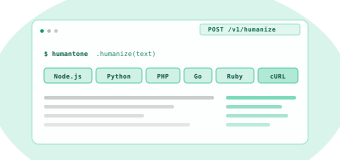
Run the same check programmatically. The detection endpoint returns the score as JSON and is available on all paid plans. See the API docs.
High Score. Now What.
If the text shows high AI likelihood and it needs to read naturally, rewriting works better than patching individual sentences. The AI Humanizer applies real semantic rewriting that reduces AI-like phrasing while keeping facts and meaning intact. The result depends on the type of content and the specific detector, so no particular score is guaranteed. Check, rewrite, check again.
FAQ
Questions &
Answers.
Everything you need to know before you start.
Content That Sounds Human.
Published Faster.
Start with 1,000 free words. No credit card. See the result in seconds.